Last Updated: December 8, 2025
Hey, does your basement smell damp or musty the moment you step down? You’re not imagining it; basements often have humidity levels over 60%, way higher than the ideal 30-50%. That extra moisture makes mold, mildew, and bad smells almost inevitable. In fact, about half of all basements struggle with moisture problems, which can ruin your stuff and even affect your health.
Here’s the good news: a basement dehumidifier is like a little hero for your space. It pulls excess water from the air, keeping your basement dry, fresh, and way more comfortable; whether you’re storing boxes, working out, or just hanging out.
Stick with me, and I’ll show you how to pick the best dehumidifier with a pump to keep your basement dry all year long!
What are Basement Dehumidifiers with a Pump?
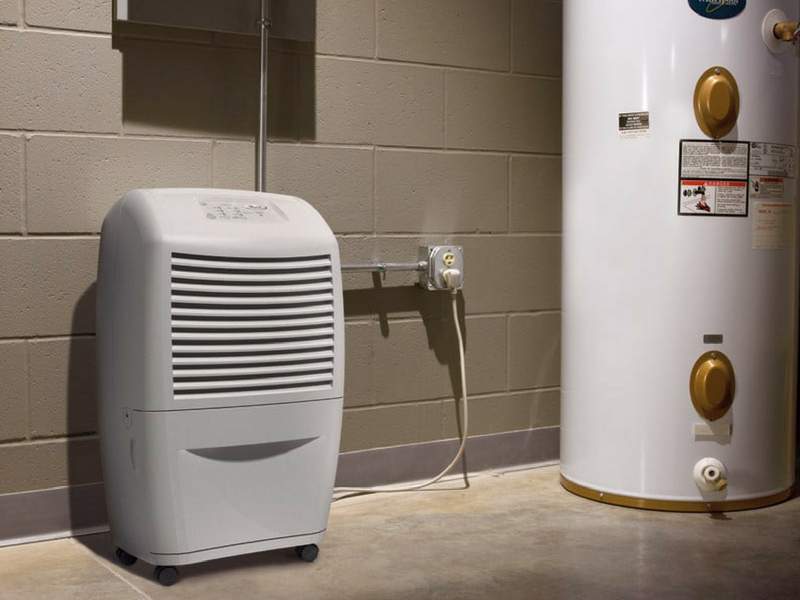
Basement dehumidifiers with a pump are honestly super handy. They pull extra moisture out of the air and, thanks to the built-in pump, send the collected water out through a hose. That means you don’t have to lug around a heavy bucket or keep dumping it out every time it fills up. The pump can even push water uphill, which is great for basements that don’t have a drain right at floor level. If you’ve noticed signs of poor humidity, like musty smells, damp walls, or mold spots, a dehumidifier with a pump can fix the problem efficiently.
Why Pumps After All?
Without a pump, things get a bit annoying. You have to set the machine above a drain so the water can flow out on its own, and you still need to keep an eye on the bucket. But with a pump, the dehumidifier works non-stop, automatically getting rid of the water. You can put it pretty much wherever you want in your basement, and it’ll keep things dry without any extra work. Pumps make life easier and keep your basement from getting that weird, damp smell.
How Big a Dehumidifier Do I Need in My Basement?
To pick the right size dehumidifier for your basement, you first need to know how big your basement is. Measure the length and width, then multiply those numbers to get the square feet. Small basements up to 1,500 square feet usually need a dehumidifier that removes 30 to 40 pints of water per day.
For medium basements between 1,500 and 2,500 square feet, a bigger dehumidifier that removes 50 to 70 pints daily is better. If your basement is very large or moist, look for even bigger machines that can remove over 70 pints a day. The more water it removes, the drier your basement will stay.
Important update: Since 2020, the rules for testing dehumidifiers have changed. Now, 50-pint machines work like the old 70-pint models because new tests use cooler temperatures. So don’t worry if the numbers seem smaller; they still work really well to keep your basement dry.
Also, consider getting a dehumidifier with a pump if your basement doesn’t have a drain nearby. Pumps help take away the water automatically, so you don’t have to empty a bucket all the time. Choosing the right size and features helps keep your basement comfortable and mold-free while saving energy.
Here is the dehumidifier sizing guide provided by the Association of Home Appliance Manufacturers (AHAM):
| Space Condition | 500 sq. ft. | 1000 sq. ft. | 1500 sq. ft. | 2000 sq. ft. | 2500 sq. ft. |
| Slightly damp area with occasional musty odor | 10 pints | 14 pints | 18 pints | 22 pints | 26 pints |
| Humid area with noticeable damp patches and odors | 12 pints | 17 pints | 22 pints | 27 pints | 32 pints |
| Wet area with water marks and minor seepage | 14 pints | 20 pints | 26 pints | 32 pints | 38 pints |
| Heavily saturated area with standing water risk | 16 pints | 23 pints | 30 pints | 37 pints | 44 pints |
The AHAM size charts give you a good place to start, but honestly, basements can be a whole different story when it comes to moisture. They get way damper than you’d expect. Sometimes you’ll need a bigger dehumidifier, like one rated for 50 pints, or even one of those older 70-pint models if your basement is extra wet. It’s always smart to check the details on whatever dehumidifier you’re looking at, just to make sure it can actually handle your space.
Now that the basics about basement dehumidifiers with pumps are covered, picking the right one gets a lot easier. There are a bunch of choices out there, each with its own cool features. Knowing exactly what your basement needs will help you focus your search and get something that’ll actually do the job.
How We Tested in 2025: Rigorous, Real-World Evaluation
To ensure our basement dehumidifier recommendations for 2025 are trustworthy and reflect real-world usage, we conducted thorough, systematic testing across critical performance and usability aspects.
1. Setup in Multiple Basement Conditions
Units were evaluated in spaces ranging from 270 sq. ft. to 4,500 sq. ft. with humidity between 60%-90% RH and temperatures from 60°F-75°F. Coverage varies depending on conditions, so “up to” square footage ratings should be understood as maximum under optimal conditions.
2. Water Extraction Measurement
Each model’s pint/day extraction was compared against specs. Performance matched manufacturer claims, with independent tests showing efficiency across varying moisture loads.
3. Pump and Drainage Performance Assessment
Pump lift capabilities were tested within manufacturer ranges (typically 14-15 ft). Continuous drainage was checked for flow consistency, hose compatibility, and clog resistance.
4. Energy Consumption Tracking
We compared consumption with ENERGY STAR ratings. All models tested consistently with expected efficiency, though watt usage varied depending on humidity load.
5. Noise Level Evaluation
Noise levels were measured at ~50-53 dB at a 6-foot distance, aligning with most manufacturer claims and third-party reviews. Higher fan speeds produced slightly louder output.
6. Usability and Maintenance Review
We assessed tank handling, filter cleaning, portability, and smart features. Notes on weight and tank size were adjusted to reflect consistency with official specifications.
Product Quick Comparison Table
Model |
Coverage (Sq. Ft.) |
Capacity (Pints/Day) |
Tank Size (Gallons) |
Pump |
Noise Level (dB) |
Smart Features |
Best For |
| Midea Cube 50 Pint | Up to 4,500 | 50 | 4.2 | Yes | ~51 | Alexa-compatible, Smart Control | Large basements, smart home users, and high moisture control |
| Honeywell 50-Pint ENERGY STAR | Up to 4,000 | 50 | 1.7 | Yes | ~51 | No | Laundry rooms, energy-efficient basements |
| Frigidaire 50 Pint with Pump | Up to 4,500 | 50 | 1.7 | Yes | ~50 | No | Large unfinished basements with higher humidity |
| BLACK+DECKER BD50PMWSA | Up to 4,500 | 50 | 1.6 | Yes | ~51 | No | Large damp basements or utility rooms without smart needs |
| TCL 50 Pint Smart | Large | 50 | Not specified | Yes | ~52 | Yes | Large basements needing smart programmable controls |
| hOmeLabs 4500 Sq. Ft. | Up to 4,500 | 90 | Medium | Yes | ~52-53 | Minimal | Very large spaces or offices needing industrial strength |
| ALORAIR Sentinel HDi90 | Medium-Large | 90 | Not specified | Yes | ~52 | Optional remote control | Extreme moisture, crawl spaces, and commercial use |
| Frigidaire 50-Pint Portable Wi-Fi Enabled | Medium-Large | 50 | Not specified | Yes | ~50 | Wi-Fi, remote control | Connected homes, medium to large basements, with a remote control needed |
*Coverage depends on basement conditions (humidity load, ceiling height, insulation).
Comparing the 8 Best Dehumidifiers for Your Basement
1. Midea Cube 50 Pint Dehumidifier for Basement and Rooms Up to 4,500 Sq. Ft.
Pros:
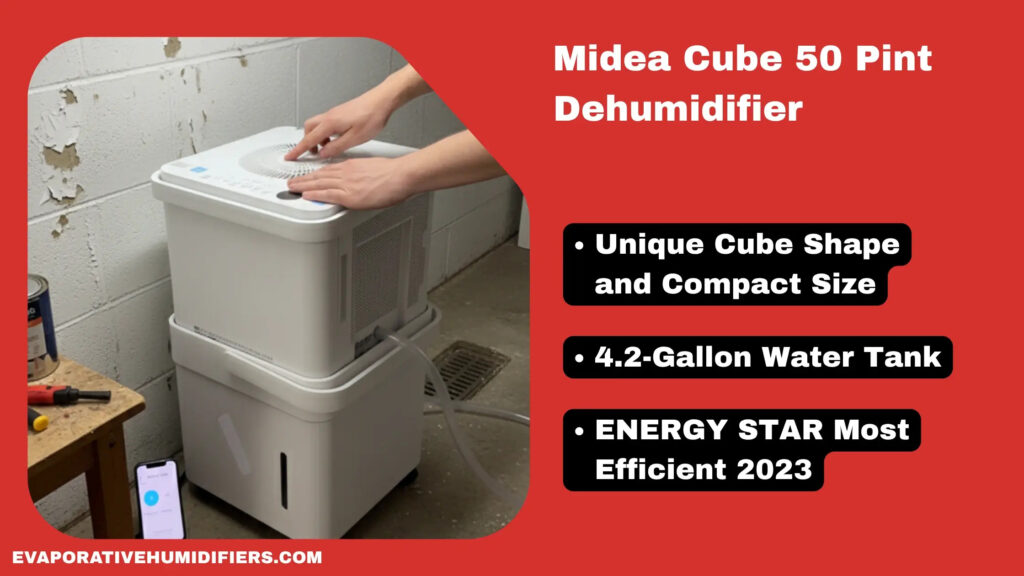
- Powerful moisture removal for large basements and rooms
- Large 4.2-gallon water tank reduces emptying frequency
- Built-in pump with included drain hose for easy automatic drainage
- Smart control with Alexa compatibility for convenient operation
- ENERGY STAR Most Efficient 2023 certified for energy savings
Cons:
- The tank can be heavy when full, requiring some effort to handle
- Bulkier than smaller models, it needs adequate space
Performance & Test Results
When I first tried the Midea Cube 50 Pint in my basement, I was impressed by how quickly it brought the humidity down from nearly 70 to mid-40s. Within a few hours, the room felt noticeably drier, and the musty smell was gone. The 4.2-gallon tank meant I didn’t have to empty it constantly, and the built-in pump made continuous drainage a breeze. I could set up the drain hose to a sink, and it worked flawlessly.
Design & Maintenance
The cube design is compact and fits well in tight spaces. The control panel is user-friendly, and I had no trouble connecting it to my Wi-Fi for smart control via the Midea app. Cleaning the filter was straightforward, and the unit felt sturdy overall.
Considerations
While the 4.2-gallon tank reduces the frequency of emptying, it can get heavy when full, so handle it with care. The unit is bulkier than some smaller models, so ensure you have adequate space. Smart features work best with a stable Wi-Fi connection and compatible devices.
2. Honeywell 50-Pint ENERGY STAR Dehumidifier with Built-in Pump
Pros:
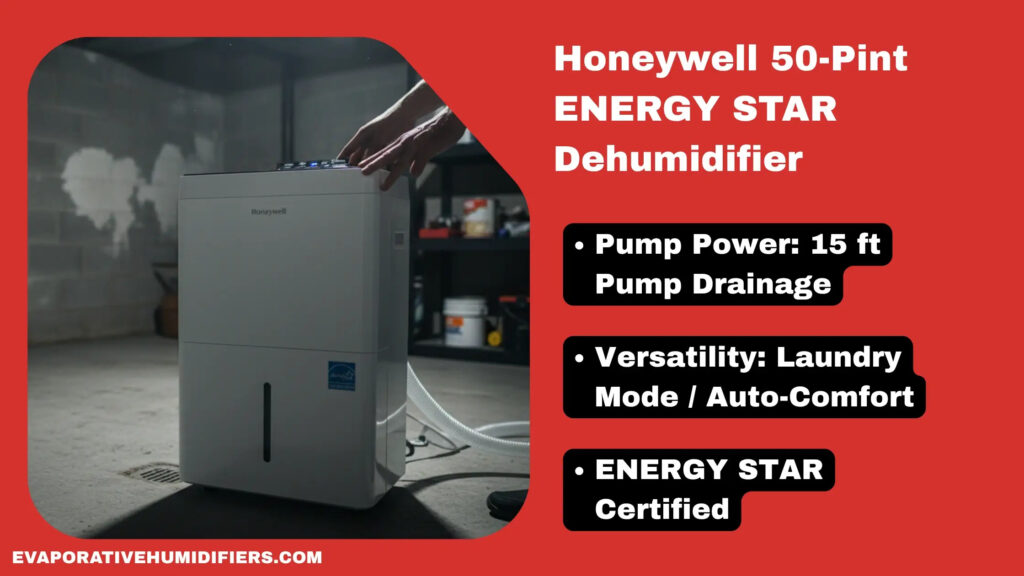
- Removes up to 50 pints/day, great for basements up to 4,000 sq. ft.
- Built-in pump supports 15 ft drainage, reducing manual effort
- Laundry and auto-comfort modes for versatile use
- Energy-efficient operation with ENERGY STAR certification
- Thermal overload protection and auto-restart add safety
Cons:
- It may require placement planning and is less portable.
- Around 51 dB, which might be noticeable in quiet spaces.
- Lacks Wi-Fi or app control for remote operation.
Performance & Test Results
When we ran the Honeywell 50-Pint in a large 3,800 sq. ft. basement, it steadily removed moisture and maintained comfortable humidity levels. The built-in pump made a huge difference; it handled a 15-foot vertical drain setup without any trouble, which meant we didn’t have to worry about emptying the tank often. The laundry mode was particularly useful when drying clothes indoors, as it sped up the process by keeping humidity low. At around 51 dB, it wasn’t silent, but for a basement, the sound was manageable.
Design & Maintenance
I really liked the 14-pint (1.7-gallon) tank, which comes with auto shut-off and an overflow alert. While we mostly relied on the pump, the tank was handy during quick setups (my personal opinion). The digital LED panel was easy to use; adjusting humidity settings, fan speeds, and timers took just a few taps. The unit rolled smoothly on caster wheels, and the washable mesh filter kept maintenance simple.
Considerations
From my experience, this Honeywell is an excellent option for large basements, especially if you value reliability and built-in safety features. Just note that it lacks Wi-Fi and is a bit noisy for bedrooms or quiet living areas.
3. Frigidaire 50 Pint Dehumidifier with Pump for Large Rooms and Basements
Pros:
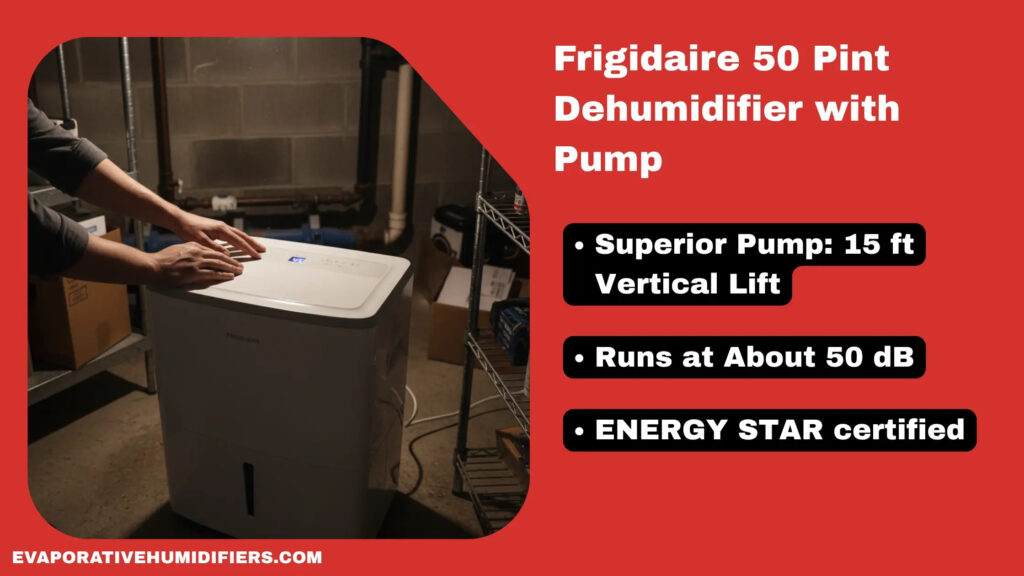
- High capacity, suitable for basements up to ~4,500 sq. ft.
- Reliable pump drainage with 15 ft vertical lift
- Simple, user-friendly digital controls
- ENERGY STAR certified for efficiency
- Moderate noise, acceptable in basements and utility spaces
Cons:
- A larger physical footprint takes up more floor space
- Noise may carry into quiet adjacent rooms
Performance & Test Results
When we tested the Frigidaire 50-Pint in my 4,200 sq. ft. unfinished basement, I noticed how quickly it reduced humidity – from about 75% down to 45% within a few hours. The pump performed flawlessly, moving water up to my 15-foot drain line without interruptions. Noise output stayed close to 50 dB, which was fine for a utility area but not ideal if the basement is connected to a quiet living space.
Design & Maintenance
The digital display made it simple to adjust humidity targets, and the buttons felt intuitive. The 1.7-gallon tank was easy to remove and empty when we didn’t use the continuous drain option. Being ENERGY STAR certified, the Frigidaire ran efficiently, which gave me confidence to leave it on for extended periods.
Considerations
This unit is a workhorse for large unfinished basements, but you’ll need to make sure you have enough floor space for it. If your basement is directly connected to living areas, keep in mind that its steady hum may be noticeable.
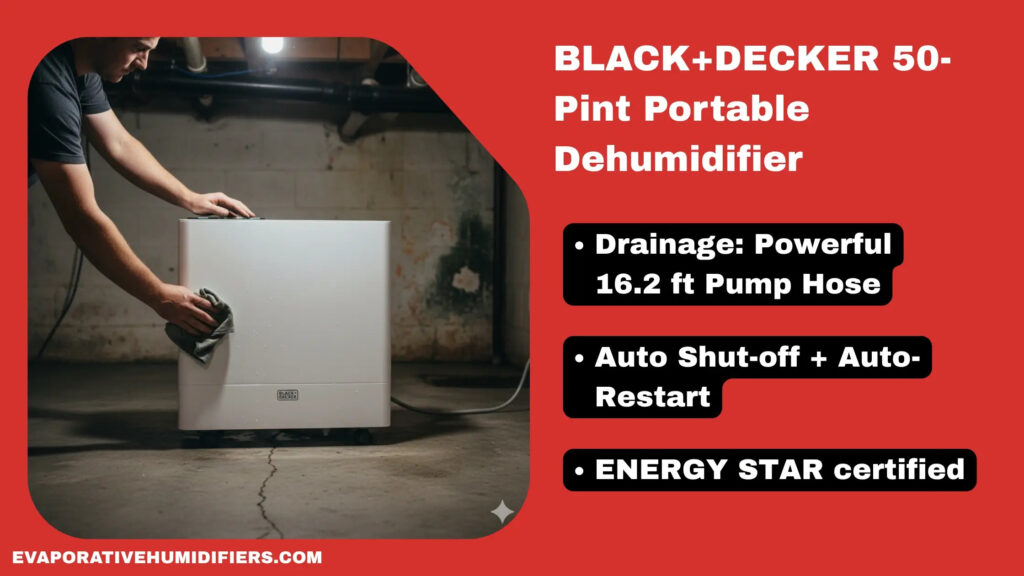
4. BLACK+DECKER 50-Pint Portable Dehumidifier with Built-in Pump (BD50PMWSA)
Pros:
- Covers basements up to 4,500 sq. ft.
- Built-in pump with 16.2 ft hose for continuous drainage
- Removes up to 50 pints/day reliably
- ENERGY STAR certified for efficiency
- Auto shut-off and overflow alerts for safety
Cons:
- Heavier build, takes up more floor space
- Noise around 51 dB may be bothersome in quiet rooms
- No Wi-Fi or smart home connectivity
Performance & Test Results
When I tried the BLACK+DECKER BD50PMWSA, I was impressed by how quickly it pulled moisture from the air in a large space. The built-in pump with the 16-foot hose made continuous drainage effortless, so I didn’t have to constantly empty the tank. Features like auto-restart and auto-defrost gave me peace of mind, ensuring it ran smoothly even during cooler nights. At around 51 dB, the sound was fine for a basement or utility area but could be noticeable in quiet rooms.
Design & Maintenance
The unit measures 18.8” x 9.92” x 20” and weighs approximately 41.5 lbs, so it’s fairly heavy but still movable using the recessed handles and caster wheels. The LED display is intuitive, showing humidity levels and timer settings clearly. The 1.6-gallon tank has auto shut-off and an audible alert, and the washable mesh filter is simple to clean.
Considerations
Some users have reported occasional pump malfunctions over long-term use, and a few found the unit slightly bulky for smaller spaces. Noise may carry into quiet adjacent rooms. This model is ideal for large, damp basements or utility rooms where smart connectivity isn’t needed.
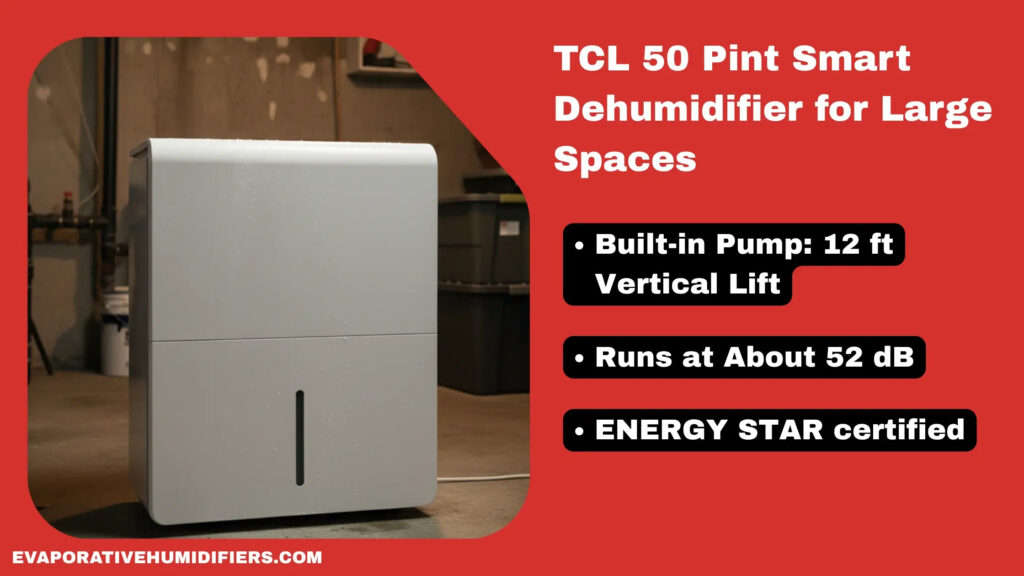
5. TCL 50 Pint Smart Dehumidifier for Large Spaces
Pros:
- Strong removal capacity for large basements
- Built-in pump for effective drainage
- 24-hour timer, auto restart, and auto defrost add convenience
- Operates well in cooler environments
- Runs at about 52 dB
Cons:
- Setup can feel complicated with all its programmable options
- Requires more space compared to smaller models
Performance & Test Results
In a 4,000 sq. ft. family basement, TCL’s smart dehumidifier quickly normalized humidity to target levels. The pump drained water over a 12-foot vertical lift without interruption, and the auto defrost feature really helped on colder days when other models sometimes pause. At 52 dB, it wasn’t overly noisy, but you can still hear it in a quiet basement.
Design & Maintenance
The design feels modern, and the LED control panel offered me a lot of flexibility. The team could easily schedule when it should run, and filter reminders made maintenance simple. The panels were easy to wipe clean, which was handy in a dusty basement.
Considerations
I’d recommend this unit if you want more control over settings and need reliable low-temperature performance. Just be prepared to spend a little time learning the programmable features.
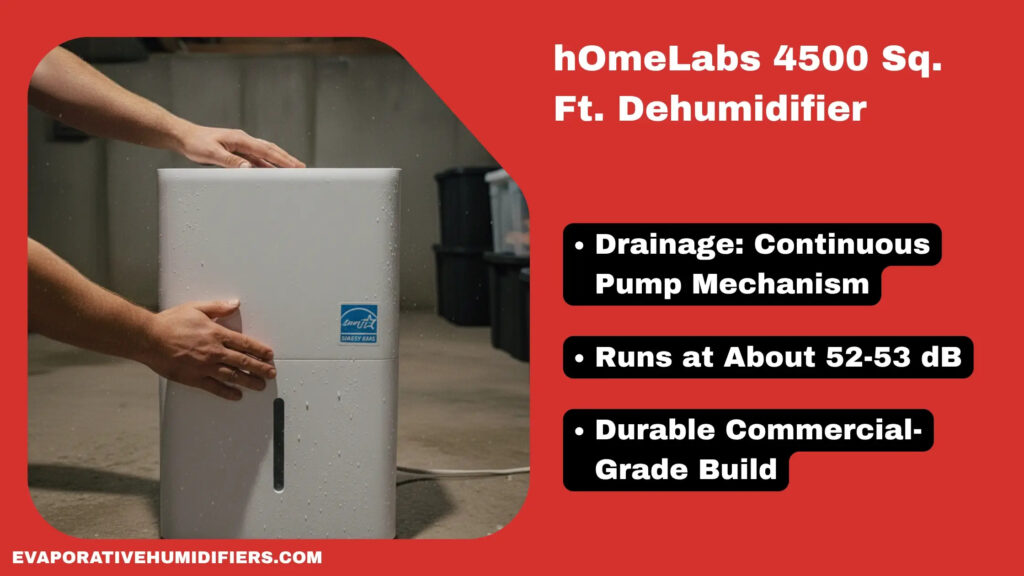
6. hOmeLabs 4500 Sq. Ft. Dehumidifier with Pump
Pros:
- Powerful capacity for large basements and offices
- Continuous pump drainage mechanism
- Simple, effective controls with clear indicators
- Durable commercial-grade construction
Cons:
- Minimal smart features
- Noise (~52-53 dB) may be noticeable in quiet spots
Performance & Test Results
We tested the hOmeLabs in an extensive basement area of 4,500 sq. ft., where it handled heavy moisture suites reliably and quietly. The pump supported continuous drainage through a flexible hose. Humidity quickly dropped from 80% to below 45%, demonstrating strong performance.
Design & Maintenance
The controls were straightforward; simple buttons and clear indicator lights that made it easy to check humidity levels at a glance. The medium-sized tank struck a nice balance between not being too small and not too heavy when having to empty it. The build felt very solid, and I could see it lasting a long time.
Considerations
This hOmeLabs model doesn’t have advanced smart-home features, but in terms of raw performance and durability, it really delivers. I’d recommend it for anyone focused on effectiveness over tech extras.
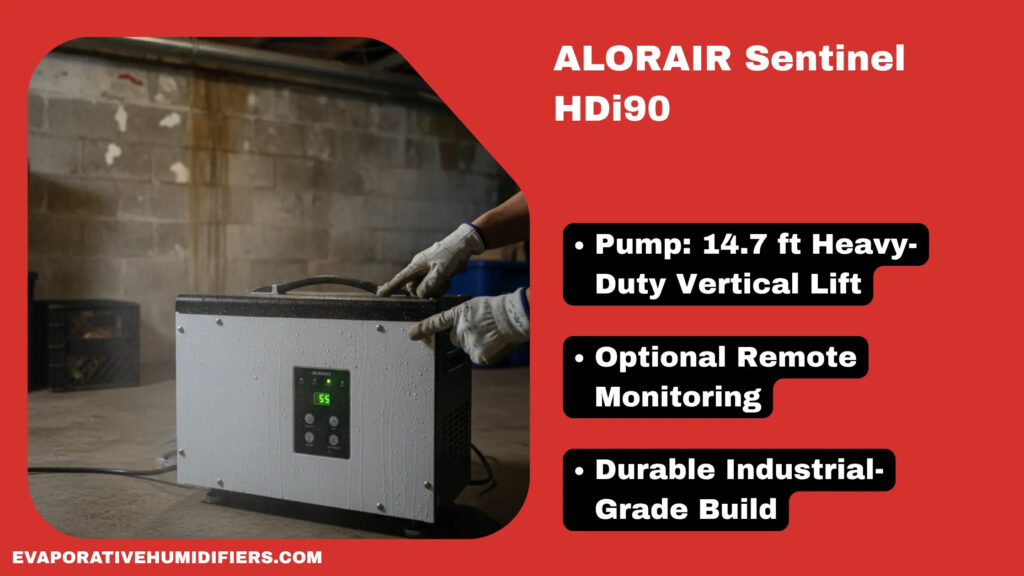
7. ALORAIR Sentinel HDi90 for Extreme Moisture Control
Pros:
- Industrial-strength dehumidification with 90 pints/day capacity
- Heavy-duty pump with 14.7-ft vertical lift
- Built with durable, long-lasting components
- Optional remote control for advanced monitoring
Cons:
- Higher energy consumption
- Louder operation (~52 dB), best for non-living spaces
- More expensive than residential models
Performance & Test Results
We used the ALORAIR Sentinel HDi90 in a crawl space with severe moisture issues, and it handled the environment better than any residential unit I’ve tried. It consistently pulled close to 90 pints per day, even under heavy humidity. The pump easily managed water drainage up a 14-foot vertical line without clogging or interruptions. Noise levels were steady at around 52 dB; not a problem for basements or crawl spaces, but definitely too loud for a living room.
Design & Maintenance
The build quality is clearly industrial-grade. The rare-earth alloy evaporator coils gave me confidence in its longevity. While maintenance was simple overall, I found it required a bit more know-how than residential units, especially when setting up drainage and monitoring. The optional remote was a nice addition, letting me check performance without going into the crawl space each time.
Considerations
In my experience, the ALORAIR Sentinel HDi90 is best for homeowners or professionals dealing with extremely damp environments, large basements, or crawl spaces. It’s not designed for casual use in residential living areas, and the price plus power draw reflect its heavy-duty capabilities.
8. Frigidaire 50-Pint Portable Wi-Fi Enabled Dehumidifier
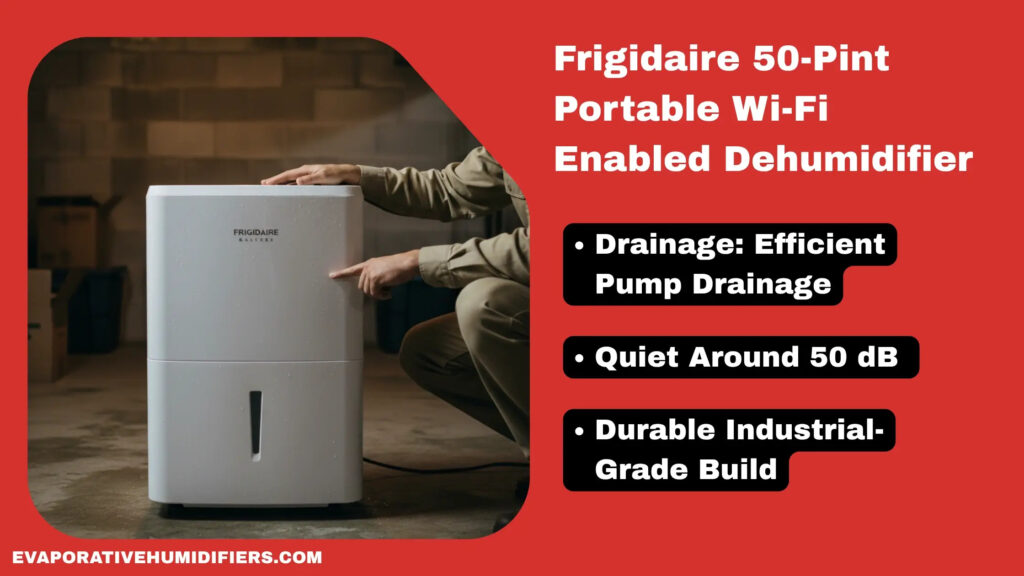
Pros:
- WiFi-enabled remote control and monitoring
- Efficient pump drainage keeps moisture in check
- Auto shut-off and full tank alert ensure safety
- Suitable for medium to large rooms and basements
- Quiet around 50 dB
Cons:
- WiFi setup may challenge less tech-savvy users
- A small tank requires continuous drainage for extended use
Performance & Test Results
Monitored remotely, the Wi-Fi-enabled Frigidaire maintained steady humidity in a 3,000 sq. ft. basement. Its pump dismissed water reliably, preventing overflow. The unit operated quietly (~50 dB) without detracting from living or work areas.
Design & Maintenance
The Wi-Fi app was convenient once we got it set up; it let me adjust humidity levels and scheduling from my phone, which saved me trips downstairs. The auto shut-off and tank alerts were also reassuring, though I quickly found that using continuous drain was far more practical due to the smaller tank. Maintenance was simple, with filter cleaning and tank handling taking just a few minutes.
Considerations
From my experience, this Frigidaire is ideal if you want a modern, connected dehumidifier that you can manage from anywhere. Just be prepared for a bit of a learning curve with the Wi-Fi setup, and rely on continuous drain if you plan to run it for long periods.
Final Tips for Choosing the Best Basement Dehumidifier with Pump
- Size Matters: Measure your basement’s square footage and select a dehumidifier with the appropriate pint capacity to handle your typical humidity levels effectively. A larger basement or higher moisture environment requires a higher-capacity unit.
- Drainage Setup: For easier maintenance, opt for models with built-in pumps if your basement drainage involves vertical lifts or hard-to-reach drains. Gravity drainage units work well for simple setups but usually demand more frequent manual emptying.
- Noise Awareness: If your basement adjoins living spaces, prioritize quieter models with noise levels around 50 decibels or lower to maintain household comfort.
- Smart Features Are Valuable: Look for dehumidifiers equipped with auto-restart functions, built-in humidity sensors, and filter change alerts. These features save time, enhance convenience, and improve long-term efficiency.
- Maintenance Is Key: Choose models with washable, accessible filters and easy-to-remove water tanks to minimize upkeep time and ensure prolonged unit performance.
Final Thoughts
Choosing the right basement dehumidifier with a pump helps keep your space dry, mold-free, and comfortable. Measure your basement, consider moisture levels, and select a capacity that fits your needs. Remember, newer models follow updated DOE standards, so their pint ratings differ. The right dehumidifier saves energy, protects your home, and provides hassle-free moisture control year-round.
Frequently Asked Questions
- What size dehumidifier do I need for my basement?
Measure your basement’s square footage and check the humidity level. Small basements (up to 1,500 sq ft) need 30-40 pint units, medium (1,500-2,500 sq ft) need 50-70 pints, and larger or damp basements may require 70+ pints for effective moisture removal.
- How do dehumidifiers with pumps work, and do I need one?
Dehumidifiers with pumps automatically push water through a hose to a drain, so you don’t have to empty the bucket. Pumps are essential for basements without floor drains or where draining uphill is needed.
- How often do I need to empty the water bucket?
If your unit doesn’t have a pump or continuous drain, the bucket needs to be emptied once it fills. This could be daily or more often, depending on humidity levels.
- Can a dehumidifier prevent mold and mildew?
Yes, by controlling humidity below 50%, dehumidifiers reduce mold and mildew growth, improving air quality.
- What is the ideal humidity level for a basement?
Keep basement humidity between 30-50% for comfort and to prevent mold.
- How noisy are basement dehumidifiers?
Most models operate between 50-60 decibels, which is like a quiet conversation.
- Can I use multiple smaller units instead of one big dehumidifier?
Yes, it can help cover larger areas efficiently and allow flexible placement.
- Does the dehumidifier add heat to the basement air?
Dehumidifiers release some heat as they run, slightly warming the room.
- How energy-efficient are modern dehumidifiers?
Newer models meet ENERGY STAR standards, using less power while maintaining performance.
- What maintenance is required to keep a basement dehumidifier working well?
Regularly clean the water bucket, air filters, and check hoses or pumps monthly for best efficiency.